North & North · Peptide Catalog
GHK-Cu
Copper Peptide Complex
Your body already makes this one, and makes less of it as you get older. GHK-Cu is that same tripeptide bound to copper, and it is the reason copper peptides ended up in skincare at all.
The short version
What GHK-Cu actually is
Three amino acids, glycine, histidine and lysine, arranged so they grip a copper atom and hold onto it. It occurs naturally in blood plasma, and the decline in it with age is a large part of why it drew attention for skin and repair research in the first place.
Sold for research purposes only.
The mechanism
How GHK-Cu Works
It is not something added to the skin. It is a signal the body already uses.
The prevailing description is that GHK-Cu acts as a carrier and a signal at the same time. It delivers copper in a form cells can use, and separately it appears to influence the signaling around repair and remodeling rather than forcing any single process. That dual role is why it turns up in wound research and cosmetic research at once, and why it is studied as a messenger rather than an ingredient.
Where the science stands
Key Research Areas
- 01
Skin renewal
The largest body of work by far. Studies look at how it behaves around fibroblasts, the cells that build and organize collagen, and at what happens to skin structure when they are more active.
- 02
Collagen and the scaffolding around cells
Not just how much collagen there is, but how it is arranged. The support network cells sit inside determines how tissue actually holds together, and that organization is what much of this research measures.
- 03
The copper is the point
Copper is required by several enzymes involved in building tissue, but loose copper is reactive and unhelpful. Binding it into a peptide is what makes it deliverable, which is the whole design of the molecule.
- 04
Hair follicle research
A smaller but persistent line of work looks at follicle biology, which is where a lot of popular interest sits. Worth knowing it is a thinner literature than the skin research.
The evidence
What the Research Actually Did
The interesting one. A trial recruiting since February 2026 is testing a topical GHK-Cu gel on standardised wounds in 60 people, with each participant carrying both the gel and a vehicle control so they act as their own comparison. Results are not in yet.
Hudson Biotech. Phase 2 split-wound study of topical GHK-Cu gel, recruiting since February 2026. NCT07437586.Examined a GHK-Cu complex against inflammatory signaling in skin cells and how quickly keratinocytes, the main cell type in the outer layer of skin, recovered.
A Torilis japonica Extract-GHK-Cu Complex Attenuates Th2 Cytokines and Promotes Keratinocyte Recovery. Antioxidants, June 2026.Built copper peptide into a wound dressing and measured what happened in the hardest version of the problem, wounds that are both infected and slow to heal.
Copper peptide activated cascade catalysis in infected diabetic wound healing. Mater Today Bio, August 2026.
We pulled this together from published work and linked every source, so you never have to take our word for it. Nothing here is a claim about what these compounds do. We would rather you read the sources than trust the summary.
Quality and supply
GHK-Cu Specifications
- Product contents
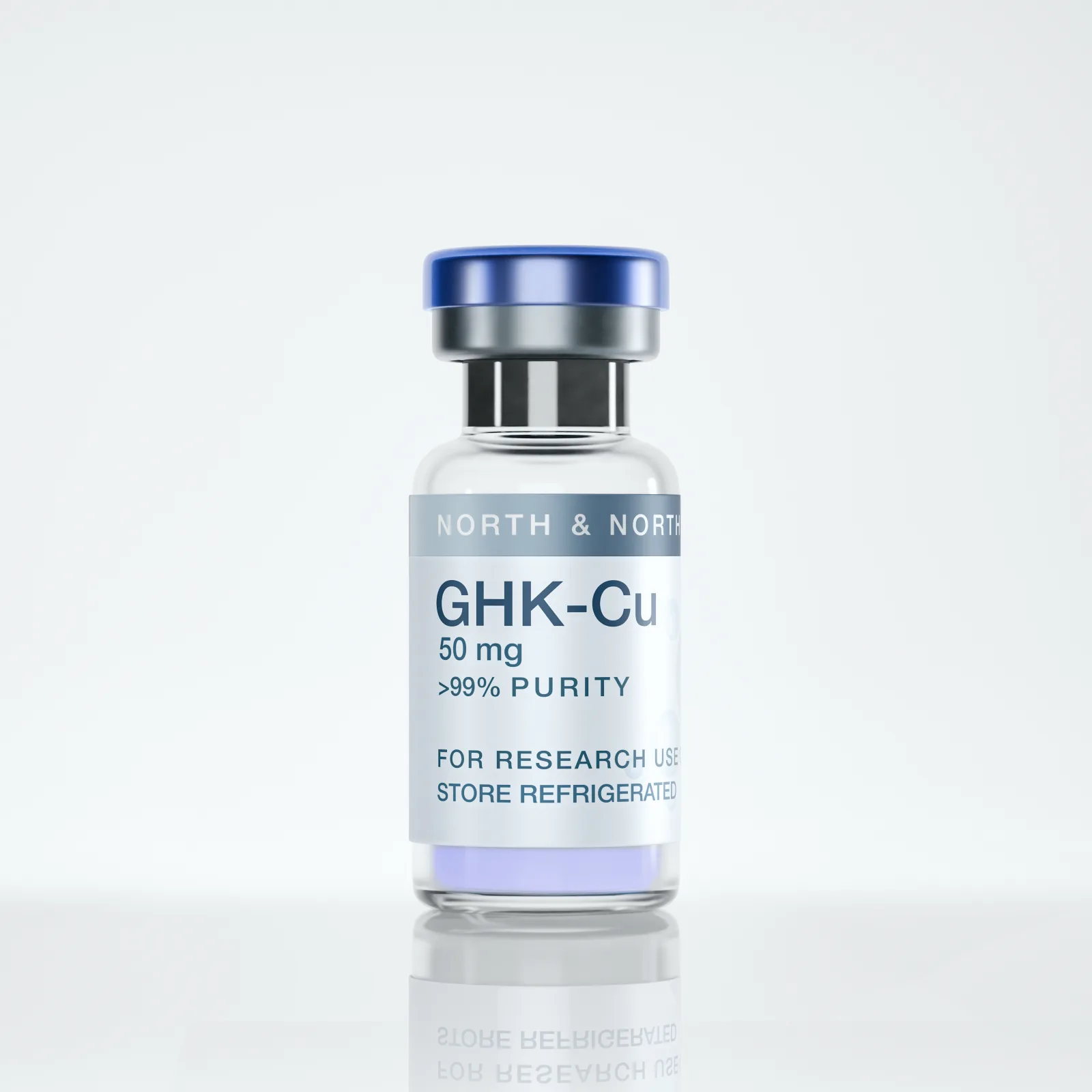
- GHK-Cu lyophilized powder in 3mL vial
- Available size
- 50mg
- Peptide type
- Copper Peptide Complex. Copper(II) binding tripeptide, 3 amino acids
- Purity
- >99% Purity · HPLC
- Storage
- Store at 6°C or below, sealed, away from heat, light, and moisture
- Solubility
- Soluble in water
- Fulfillment
- USA domestic fulfillment
- Molecular formula
- C14H24CuN6O4
- Molecular weight
- 403.93 g/mol
- Sequence
- Gly-His-Lys
- CAS number
- 49557-75-7
- PubChem CID
- 378611
- Synonyms
- GHK-Cu, GHK Cu, Copper Peptide, Copper Tripeptide-1, Gly-His-Lys:Cu(II)
- Appearance
- Blue to blue violet lyophilized powder
Common questions
Questions People Ask
What is GHK-Cu?
A naturally occurring tripeptide, glycine-histidine-lysine, bound to copper. It is found in human blood plasma, and research centers on skin renewal, collagen and tissue repair. Sold for research purposes only.
Why does it need copper?
Copper is required by several of the enzymes involved in building tissue, but free copper is reactive and not much use on its own. The peptide holds it in a form cells can actually work with. The copper is also why the powder is blue rather than white.
Is GHK-Cu the same as the Skindeep GHK-Cu system?
No. Skindeep is a cosmetic Micro-Infusion system and a separate product line. The GHK-Cu sold here is a research compound and is not part of that system.
What does >99% purity actually mean?
More than 99% of the vial contents is the peptide complex itself rather than fragments or synthesis byproducts, verified by HPLC.
How should it be stored?
Sealed, at 6°C or below, away from heat, light and moisture. It ships as a lyophilized powder and is blue to blue violet, which is the copper.
Catalog access
Create a Free Account
Create a quick and easy free account to shop GHK-Cu and other peptides.
Free to create. You will verify your email address before the catalog opens.