North & North · Peptide Catalog
KLOW
Research Peptide Blend
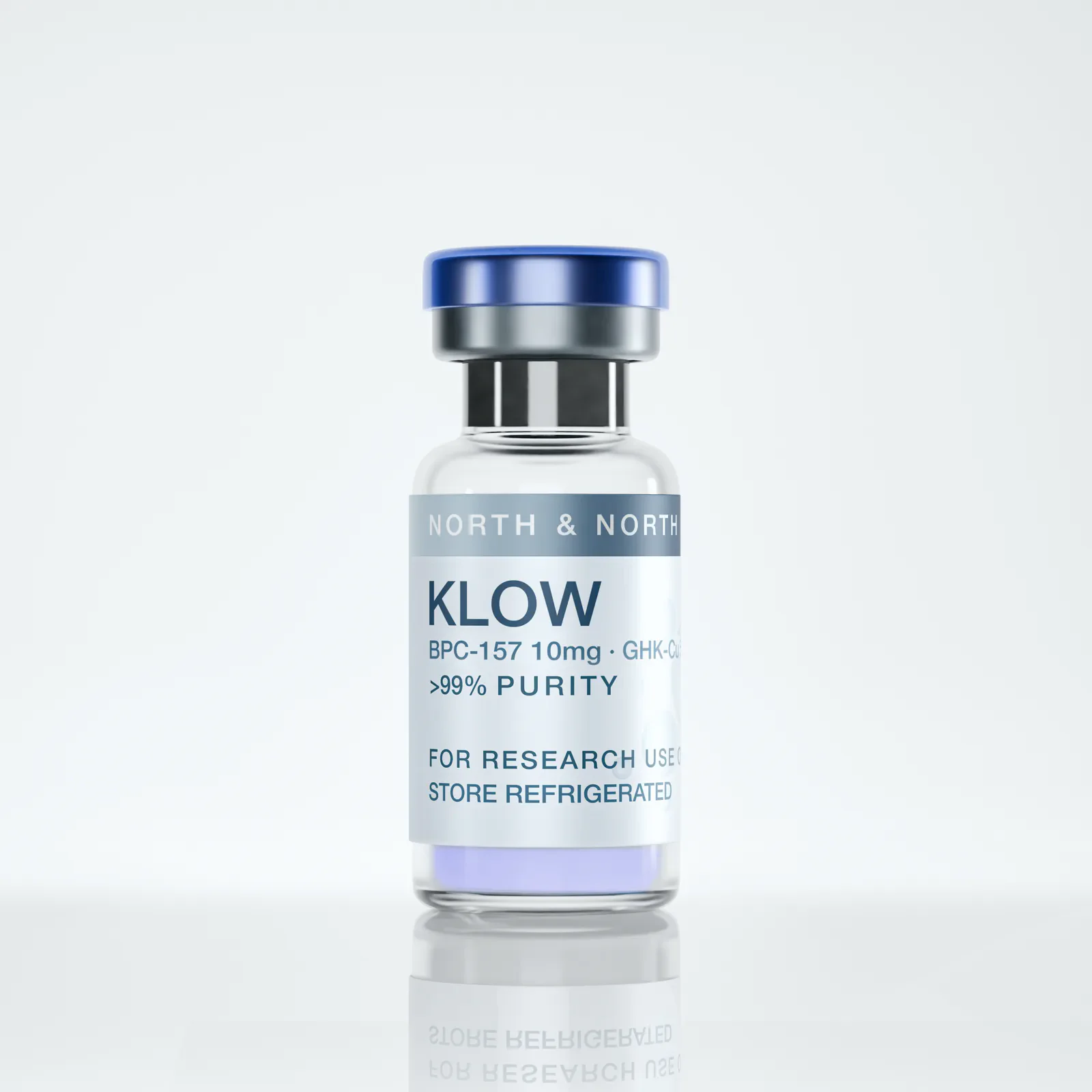
Four peptides in one vial: BPC-157, GHK-Cu, TB-500 and KPV. The first three are each sold on their own here, and each has its own research behind it. KPV is the fourth.
The short version
What KLOW actually is
10mg, 50mg, 10mg and 10mg respectively, 80mg of peptide in the vial. It is the GLOW blend with a fourth peptide, KPV, added. The first three share research territory: tissue repair, renewal and regeneration. KPV comes from a different body of work, a short fragment of a natural hormone studied in cell and rodent models.
Sold for research purposes only.
Welcome offer
15% off your first order.
Shipping not included. A free account is required.
All compounds are offered for research purposes only. Not for human consumption or therapeutic use.
The mechanism
How KLOW Works
Four peptides, four separate research stories, one vial.
There is no single mechanism here, because there is no single molecule. BPC-157 brings growth factor and vascular modulation. GHK-Cu brings copper binding and signaling. TB-500 brings actin handling. KPV is examined in cell and rodent models, where the questions have been how it is taken up through the PepT1 transporter and how inflammatory signaling responds in those models. Four different stories, each with its own evidence behind it. Whether those mechanisms talk to each other once combined is the open question, and the research has not answered it yet.
Where the science stands
Key Research Areas
- 01
BPC-157, the tendon one
Fifteen amino acids taken from a protective stomach protein, studied across tendon, ligament, blood vessel and gut repair. Almost entirely in preclinical work: its one registered human trial is a Phase 1 from 2015.
- 02
GHK-Cu, the copper one
A tripeptide that binds copper, studied in skin renewal and collagen, and in how the support network cells sit inside gets built and organized.
- 03
TB-500, the scaffolding one
Synthetic Thymosin Beta 4, studied for how cells hold and rebuild their internal skeleton, and now for heart repair in a trial beginning this year.
- 04
KPV, the fragment one
Three amino acids, lysine, proline and valine, taken from the end of alpha melanocyte stimulating hormone. Studied in cell and rodent models, mainly for how cells take it up and for inflammatory signaling in the gut. All of it is preclinical, and no human trial of KPV is registered.
- 05
Why they are grouped
The first three keep landing in the same place: repair, renewal, regeneration. KPV approaches from another direction, and no published research examines the four together.
The evidence
What the Research Actually Did
On KPV, researchers examined how the tripeptide enters intestinal cells through the PepT1 transporter, and what was measured in cell culture and in mouse models of colitis. Cells and mice, not people.
Dalmasso et al. Gastroenterology, 2008.A separate group examined KPV in mouse models of inflammatory bowel disease. Mice, not people.
Kannengiesser et al. Inflamm Bowel Dis, 2008.A review of the biochemistry of alpha melanocyte stimulating hormone and its related tripeptides, KPV among them, covering the work done in cell culture and in animals.
Brzoska et al. Endocr Rev, 2008.
We pulled this together from published work and linked every source, so you never have to take our word for it. Nothing here is a claim about what these compounds do. We would rather you read the sources than trust the summary.
Quality and supply
KLOW Specifications
- Product contents
- BPC-157, GHK-Cu, TB-500 and KPV blend, lyophilized powder in 3mL vial
- Available size
- 10 / 50 / 10 / 10mg, 80mg total
- Peptide type
- Research Peptide Blend. Synthetic pentadecapeptide (BPC-157), copper binding tripeptide (GHK-Cu), full length Thymosin Beta 4 (TB-500), tripeptide of lysine, proline and valine (KPV)
- Purity
- >99% Purity · HPLC
- Storage
- Store at 6°C or below, sealed, away from heat, light, and moisture
- Solubility
- Soluble in water
- Fulfillment
- USA domestic fulfillment
- Molecular formula
- BPC-157: C62H98N16O22 · GHK-Cu: C14H24CuN6O4 · TB-500: C212H350N56O78S · KPV: C16H30N4O4
- Molecular weight
- BPC-157: 1419.56 · GHK-Cu: 403.93 · TB-500: 4963.44 · KPV: 342.43 g/mol
- CAS numbers
- BPC-157: 137525-51-0 · GHK-Cu: 49557-75-7 · TB-500: 77591-33-4 · KPV: 67727-97-3
- PubChem CIDs
- 9941957 · 378611 · 16132341 · 125672
- Synonyms
- Klow Blend, Klow Peptide, BPC-157 GHK-Cu TB-500 KPV Blend
- Appearance
- Blue to blue white lyophilized powder. Forms a blue solution when dissolved, from the copper content
Common questions
Questions People Ask
What is in KLOW?
Four peptides in a single vial: BPC-157 at 10mg, GHK-Cu at 50mg, TB-500 at 10mg and KPV at 10mg, for 80mg of peptide in total. Sold for research purposes only.
How is KLOW different from GLOW?
KLOW is GLOW with KPV added at 10mg. The BPC-157, GHK-Cu and TB-500 amounts are the same in both vials.
Can I buy the constituents separately?
BPC-157, GHK-Cu and TB-500 are each sold on their own here, and each has its own page with its own research and specifications. KPV is not sold separately.
What is KPV?
A tripeptide of lysine, proline and valine, the last three amino acids of alpha melanocyte stimulating hormone. It has been studied in cell culture and rodent models. No human trials of it are registered.
Is there research on the blend itself?
The research is on the four constituents individually, and for KPV it is preclinical. Studies of the four together in these proportions are not something we can point you to, so the evidence on this page is theirs rather than the blend’s.
How should it be stored?
Sealed, at 6°C or below, away from heat, light and moisture. It ships as a lyophilized powder and forms a blue solution when dissolved, from the copper content.
Catalog access
Create a Free Account
Create a quick and easy free account to shop KLOW and other peptides.
Free to create. You will verify your email address before the catalog opens.