North & North · Peptide Catalog
Retatrutide
Triple Receptor Agonist
Tirzepatide pulled two levers at once and reset the field. Retatrutide pulls three, and the research program around it is now one of the largest running.
The short version
What Retatrutide actually is
A synthetic peptide built to act on three receptors rather than two: the two Tirzepatide already targets, plus the glucagon receptor. Glucagon is the surprising one. It raises blood sugar, which sounds like exactly the wrong direction, until you know it also raises how much energy the body burns.
Sold for research purposes only.
The mechanism
How Retatrutide Works
The third receptor looks like a mistake. Glucagon raises blood sugar, but it also raises how much energy the body burns, and that is the trade being tested.
Retatrutide acts on three receptors at once: GIP, the incretin receptor, and glucagon. The first two are the pair Tirzepatide established. The third is the interesting one, because glucagon is usually described as the hormone that pushes blood sugar up, which sounds like the wrong direction entirely. The proposed reasoning is that it also increases how much energy the body burns, and that combining it with the other two changes the balance rather than simply opposing them. Whether that framing holds is a live research question, not a settled one.
Where the science stands
Key Research Areas
- 01
Weight management
The center of gravity for this compound and the reason most people search for it. A large Phase 3 program has been reading out through 2025 and 2026, so the published picture is changing faster here than for anything else in our catalog.
- 02
Visceral fat
Not all body fat behaves the same way. The fat packed around the organs is measured separately in this research because it tracks differently against metabolic markers than the fat you can see.
- 03
Metabolic markers
Blood sugar handling, cholesterol fractions and blood pressure get reported alongside the weight numbers in these trials, which is why the compound shows up in metabolic research and not only in weight research.
- 04
Appetite signaling
The receptors involved sit in the gut and the brain both, which is why appetite is measured in this research rather than inferred from the weight numbers.
- 05
The glucagon question
The genuinely open question. Glucagon raises blood sugar, so building it into a compound aimed at metabolic research reads backwards until you look at what it does to energy expenditure. That tension is what researchers are actually studying.
The evidence
What the Research Actually Did
The study that put this compound on the map. A Phase 2 trial in adults with obesity, placebo controlled over 48 weeks, and the basis for the much larger program that followed.
Jastreboff et al. Triple-Hormone-Receptor Agonist Retatrutide for Obesity, A Phase 2 Trial. N Engl J Med, August 2023.The Phase 3 program reporting through 2026, across eight parallel trials enrolling more than 5,800 participants, plus a separate cardiovascular outcomes study. This is the current state of the record rather than the 2023 starting point.
Eli Lilly and Company. TRIUMPH Phase 3 program topline results, December 2025 through July 2026.The registry record for the Phase 2 study, including design and enrollment criteria, for reading the study design directly rather than a summary of it.
ClinicalTrials.gov. NCT04881760.
We pulled this together from published work and linked every source, so you never have to take our word for it. Nothing here is a claim about what these compounds do. We would rather you read the sources than trust the summary.
Quality and supply
Retatrutide Specifications
- Product contents
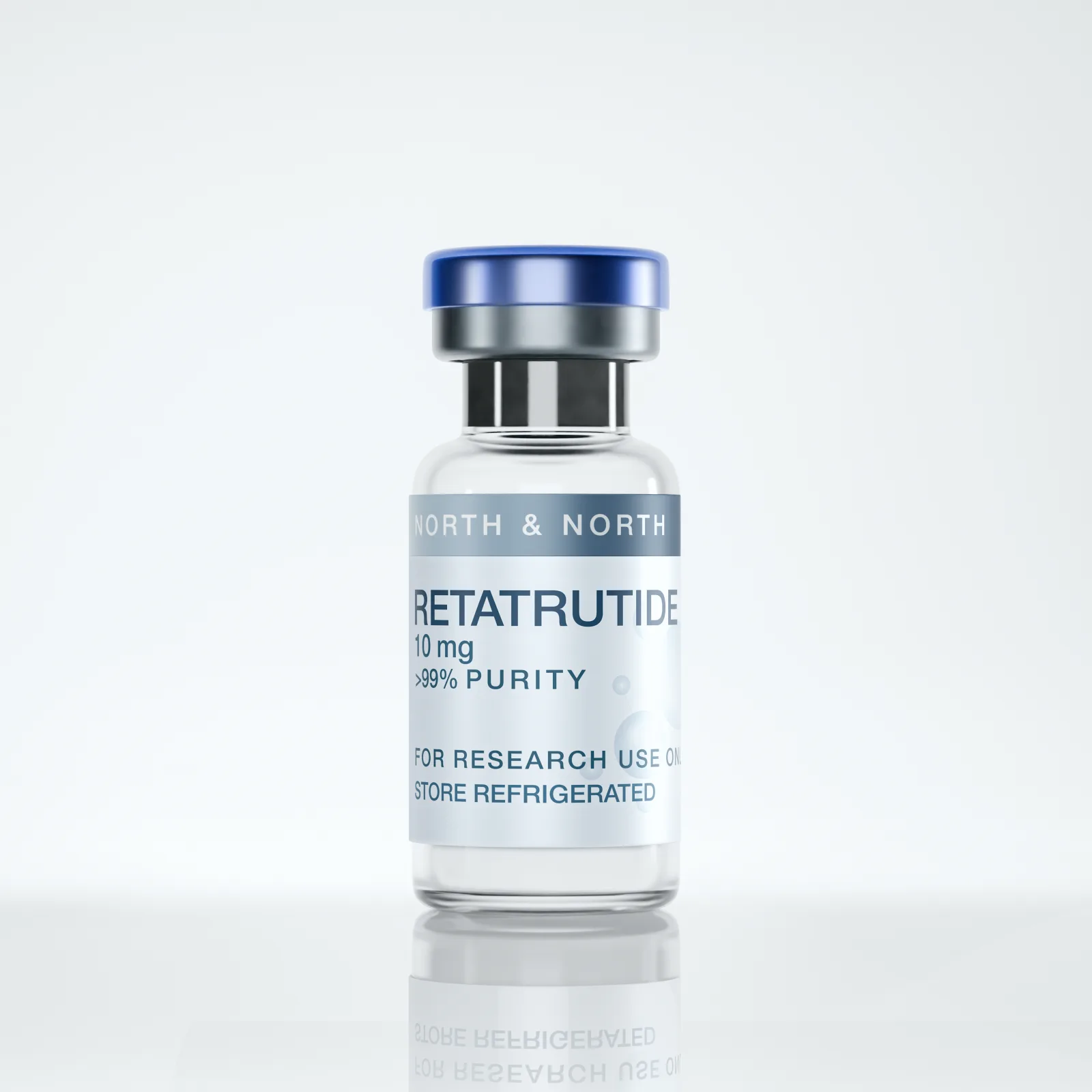
- Retatrutide lyophilized powder in 3mL vial
- Available sizes
- 10mg · 30mg
- Peptide type
- Triple Receptor Agonist. GIP, incretin and glucagon receptors, fatty acid modified
- Purity
- >99% Purity · HPLC
- Storage
- Store at 6°C or below, sealed, away from heat, light, and moisture
- Solubility
- Soluble in water
- Fulfillment
- USA domestic fulfillment
- Molecular formula
- C221H342N46O68
- Molecular weight
- 4731 g/mol
- CAS number
- 2381089-83-2
- Synonyms
- LY3437943, LY-3437943
- Appearance
- White to off white lyophilized powder
Common questions
Questions People Ask
What is Retatrutide?
A synthetic peptide that acts as an agonist at three receptors: GIP, the incretin receptor, and glucagon. Research centers on body weight, visceral fat and metabolic markers. Sold for research purposes only.
How is it different from Tirzepatide?
Tirzepatide acts on two receptors. Retatrutide adds a third, the glucagon receptor. That single addition is the whole difference, and it is why the two are compared so often.
Why add a glucagon receptor?
It reads backwards at first, because glucagon is usually described as raising blood sugar. The proposed reasoning is that it also raises how much energy the body burns, and that the combination with the other two receptors changes the balance. Whether that holds is an open research question.
Is it approved?
No. Retatrutide remains under active clinical study and has not been approved by the FDA. North & North supplies it as research material only.
How should it be stored?
Sealed, at 6°C or below, away from heat, light and moisture. It ships as a lyophilized powder, which is the stable form.
Catalog access
Create a Free Account
Create a quick and easy free account to shop Retatrutide and other peptides.
Free to create. You will verify your email address before the catalog opens.